

Table of Contents
- Why Lint Buildup in Dryer Vents Is a Serious Problem
- Criteria for Choosing a Dryer Vent Lint Removal Service
- Our Professional Dryer Vent Lint Removal Process
- Key Benefits: Faster Drying, Lower Energy Use, and Fire Safety
- Pricing and Value: Dryer Vent Cleaning Starting at $79
- Why Dr Air Duct Is the Top Choice in Dallas
- Signs Your Dryer Vent Needs Cleaning Now
- How to Select the Right Service: Our Recommendation
- Frequently Asked Questions (FAQ)
Why Lint Buildup in Dryer Vents Is a Serious Problem
Every load of laundry sends lint through your dryer vent, and over time that lint collects inside the duct, along the wall, and at the exterior hood. In a typical Dallas home, a vent that runs 10 to 20 feet with a couple of bends can start restricting airflow within a year or two of heavy use. The problem is easy to miss because the dryer still runs and still heats, just less efficiently.
Restricted airflow forces the dryer to work harder. Hot, moist air has nowhere to go, so the drum stays humid, clothes take longer to dry, and the heating element or gas burner can overheat. That combination is what turns a routine chore into a safety concern. Lint is highly flammable, and a thick layer trapped in a warm duct is exactly the kind of buildup fire safety experts warn about.
What to do next: If your laundry takes more than one cycle, or the outside of the dryer feels unusually hot, schedule an inspection before you run another load.
Criteria for Choosing a Dryer Vent Lint Removal Service
Not every service that offers dryer vent work will clean the whole system. When comparing providers, look for these details:
- Full-length cleaning: The service should clean from the dryer connection through the wall duct to the exterior vent cap, not just the lint trap area.
- Inspection before and after: A good technician checks for damage, loose joints, and crushed or flexible foil ducting that traps lint.
- Proper equipment: Rotary brushes, high-powered vacuums, and rigid metal duct are preferred over household tools that leave residue behind.
- Trained technicians: Ask whether the crew is trained and certified, and whether they can explain what they found in plain language.
- Transparent pricing: You should know the starting price and what factors could change the final cost before work begins.
- Repair capability: If the vent is crushed, disconnected, or undersized, the provider should be able to correct it rather than sending you to another company.
What to do next: Ask any provider you are considering to describe their cleaning steps. Vague answers are a signal to keep looking.
Our Professional Dryer Vent Lint Removal Process
At Dr. Air Duct, we follow a consistent process so every dryer vent receives the same level of care.

- Consultation and inspection. We start by checking the dryer connection, the duct run, and the exterior hood. We note the duct material, length, number of bends, and any visible damage.
- Disconnect and access. We safely disconnect the dryer and access the duct so we can work the full length of the vent.
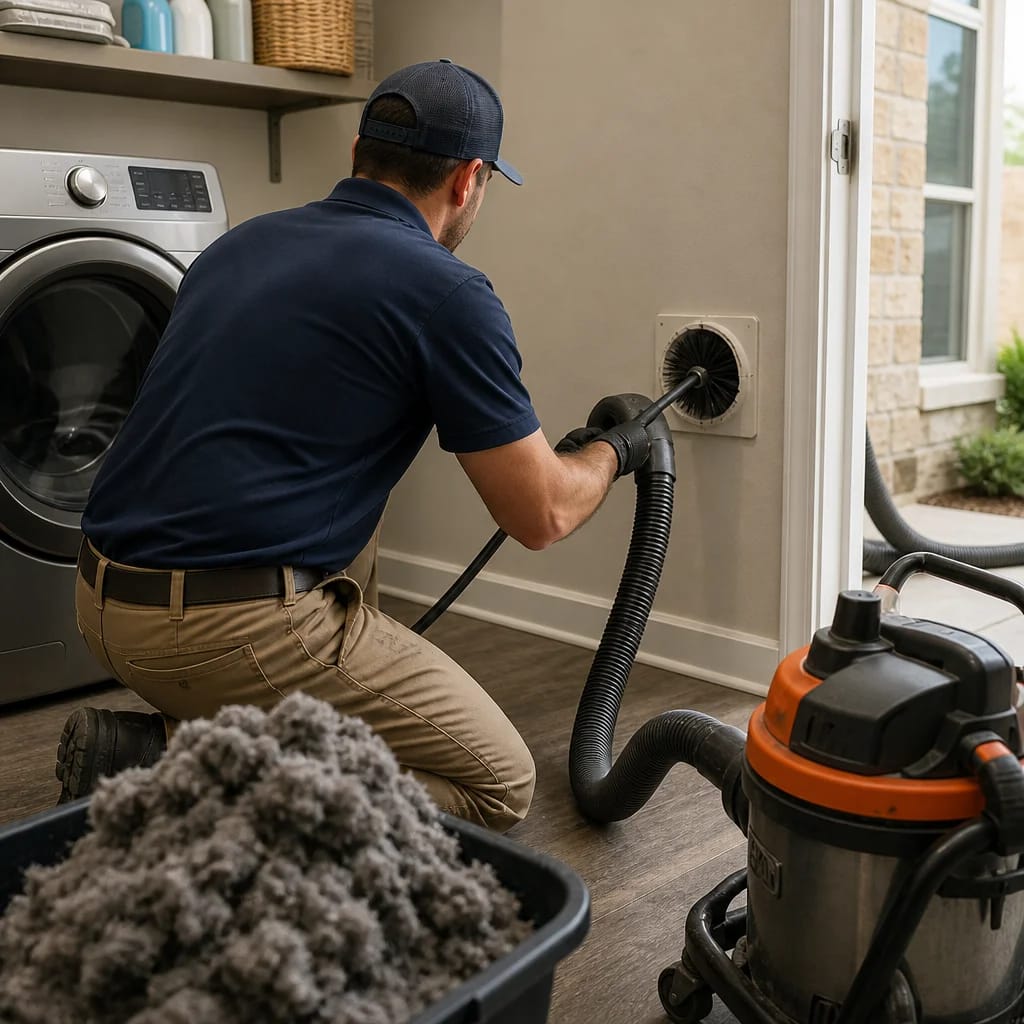
- Lint removal. Our technicians use rotary brushes and high-powered extraction equipment to remove accumulated lint and debris from the duct, the wall pass-through, and the exterior cap.
- Blockage and damage check. We look for nests, debris, collapsed sections, and loose joints. If we find a problem, we explain it and show you what we found.
- Airflow verification. Before we finish, we confirm the vent is clear and airflow is restored at the outside exhaust.
- Reconnection and cleanup. We reconnect the dryer, test it, and clean up the work area.
For example, a Plano homeowner whose dryer needed three cycles for a single load may find that a blocked exterior hood was the real problem. Clearing it along with the interior duct often restores normal drying times right away.
What to do next: Ask for a before-and-after explanation of what was removed and what was checked. A reputable technician will be glad to walk you through it.
Key Benefits: Faster Drying, Lower Energy Use, and Fire Safety
Clearing a dryer vent offers three practical benefits that homeowners and property managers notice quickly.
Faster drying. With open airflow, moist air exits efficiently and clothes dry in fewer cycles. Many customers report that loads that once took two cycles finish in one, though results vary with the age of the dryer and the load size.
Lower energy use. A dryer that is not fighting restricted airflow generally uses less energy per load. Cleaning may help reduce operating costs, but we cannot promise specific savings on your utility bill because usage habits differ widely.
Reduced fire risk. Lint buildup is a known contributor to dryer fires. Regular cleaning can help reduce that risk, though no service can eliminate it entirely. Pairing cleaning with proper dryer use, such as never running the dryer unattended and cleaning the lint trap after every load, gives you the best protection.
For commercial properties like apartment complexes and laundromats, the benefits add up across many units. Consistent maintenance also helps reduce service calls and keeps tenants happy.
What to do next: Note how long your current loads take to dry, then compare after your cleaning. This gives you a clear measure of the improvement.
Pricing and Value: Dryer Vent Cleaning Starting at $79
Our dryer vent cleaning starts at $79. The final price depends on several factors:
- Length and layout of the duct run
- Number of bends and wall penetrations
- Vent material and condition
- Whether the exterior hood or wall cap needs access work
- Whether repair or replacement of damaged sections is needed

Because we inspect before we quote, you will know what the work involves. We offer a free consultation so you can understand your options before committing. Compared with the cost of a dryer repair, a damaged drum, or a house fire, regular cleaning is a low-cost way to protect your appliance and your home.
What to do next: Request a free consultation to get an accurate quote for your specific vent layout.
Why Dr Air Duct Is the Top Choice in Dallas
Dr. Air Duct is a local Dallas-area company that handles dryer vents, air ducts, and chimneys under one roof. That matters because ventilation problems often overlap. A technician who finds a restricted dryer vent can also spot related airflow concerns and tell you whether they affect your home’s other systems.
What sets us apart:
- Trained technicians using professional-grade equipment
- Starting price of $79 for dryer vent cleaning, with a free consultation
- Fast response and availability across Dallas, Fort Worth, Arlington, Plano, Richardson, Carrollton, Denton, Lewisville, Flower Mound, and nearby communities
- Repair capability when cleaning alone is not enough
- Residential and commercial service for homes, rentals, and multi-unit properties
- Clear communication from first call through final inspection
Choosing one provider for all your ventilation needs means fewer appointments, a single point of contact, and technicians who understand your home’s full system. We would rather earn your trust with careful work than with promises.
What to do next: Contact us to schedule service or ask a question about your vent. We will give you a straightforward answer.
Signs Your Dryer Vent Needs Cleaning Now
Watch for these warning signs. If you notice more than one, schedule service soon.
- Clothes remain damp after a full cycle or need a second run
- The dryer feels hot to the touch on the outside or the laundry room feels warm and humid
- A burning or musty odor during drying
- Lint collecting around the exterior vent flap or on the outside wall
- The exterior vent flap does not open fully or stays closed when the dryer runs
- Longer drying times than usual for the same load size
- The dryer shuts off mid-cycle, which can indicate overheating
If you smell burning, turn off the dryer and call a professional before using it again.

What to do next: Check the exterior vent flap while the dryer runs. If it does not open or airflow feels weak, book an inspection.
How to Select the Right Service: Our Recommendation
When you choose a dryer vent lint removal service, prioritize full-length cleaning, a documented inspection, trained technicians, transparent pricing, and the ability to repair problems you find. Those qualities determine whether the work actually restores airflow and reduces fire risk.
Dr. Air Duct meets each of these standards. We offer dryer vent cleaning starting at $79, a free consultation, professional inspection, and the repair capability to handle issues beyond lint. Our technicians serve Dallas and surrounding North Texas communities, and our team is ready to help your home or business dry faster and run safer.
Our recommendation: Schedule your dryer vent cleaning with Dr. Air Duct. You get professional workmanship, honest pricing, and one trusted local team for your dryer vent, air duct, and chimney needs.
For further reading: Dallas dryer vent cleaning.
Frequently Asked Questions (FAQ)
How often should we clean our dryer vent?
We recommend having your dryer vent inspected and cleaned at least once a year, and more often if your household runs multiple loads a day or you have pets that shed heavily. Lint accumulates faster than most homeowners expect, and a quick inspection can show whether your vent is due for service. Our technicians will tell you exactly how much lint we removed and how your vent’s condition compares to what we typically see in Dallas homes.
What does our dryer vent lint removal process include?
We start by checking the lint trap housing, the transition duct behind the dryer, and the full length of the exhaust line to the outside. We then clear the vent using professional-grade equipment, confirm that the exterior flap opens and closes freely, and check for kinks, crushed sections, or damage that restricts airflow. You receive a clear summary of what we found and any repairs we recommend before we leave.
Can we tell if our dryer vent is causing a fire risk?
Yes, there are several warning signs, including clothes taking more than one cycle to dry, a hot laundry room, a burning smell during operation, or lint collecting around the outdoor vent opening. Any of these signals restricted airflow, which increases the risk of overheating. If you notice one of them, we can inspect the system and let you know whether immediate cleaning or repair is needed.